
A Little More Alike Than We Think
A Little More Alike Than We Think
When people first visit Con Cariño, they sometimes assume Mexican and Moroccan cultures are worlds apart.
And on the surface, I suppose it can seem that way. Different languages, different landscapes, different histories, and traditions that have grown thousands of miles apart.
But the more I have learned about Morocco, the more I have realized how much familiarity can exist inside something that seems completely different.
Family gatherings. Street food. Handmade traditions. Hospitality. The importance of the home. And, perhaps most importantly, the way we use food to care for the people around us.
For me, noticing these similarities have become more than just an interesting cultural observation. It has been part of my own journey.
From California to Morocco
In 2022, my husband and I traveled to Morocco for our honeymoon.
We packed one carry-on and a backpack each and set off on a six-week journey from the north of Morocco down to the south. We didn’t have a perfectly planned itinerary. We mostly wanted to explore, eat good food, meet people, and see where the road took us.
I remember being struck by Morocco’s beauty, but what stayed with me most was its people.
We were welcomed into homes by people we had only just met. We were offered food, tea, conversation, and a place to sit. People checked on us, made sure we were comfortable, and treated us with a warmth that felt much bigger than simple hospitality.
We arrived as travelers and left feeling like family.
And that feeling was interestingly familiar.
If you grew up visiting your Mexican tías, abuelitas, or even primos you probably know the experience.
You walk through the door and before you’ve even put your things down, someone is asking if you’re hungry.
Then comes the food.
And then more food. And then when you insist that you’re full, they look at you like that’s simply not possible.
“¡Provechito!”
“Bessaha w raha!”
In both Mexican and Moroccan homes, the kitchen is so much more than a place where food is prepared. It is often the heart of the home.
Food is how we celebrate. It’s how we welcome someone. It’s how we take care of people. And sometimes, it’s how we say things that we don’t quite know how to put into words.
The beauty of being welcomed
Sometimes, you can feel at home somewhere before you can explain why.
Morocco was still completely new to me. There were customs I didn’t understand, foods I had never tasted, words I couldn’t pronounce, and places I couldn’t yet navigate.
But the warmth of the people gave me something familiar to hold onto.
It reminded me that hospitality isn’t really about having a perfect home or preparing an elaborate meal.
It’s about making room for someone.
And that lesson has stayed with me long after that first six-week trip.
Markets that feel like a journey
If you’ve ever wandered through a Mexican mercado, you might recognize something in the souks of Morocco…
Of course, they aren’t the same. Each has its own history, traditions, crafts, foods, and rhythms. But there is a similar feeling in both.
The colors.
The smells.
The noise.
The winding paths.
The handmade goods.
The food being prepared right in front of you.
The little shops tucked around corners that make you want to keep walking just to see what’s next.
Walking through a Mexican mercado or a Moroccan souk can feel less like a typical shopping trip and more like stepping into a living part of the culture.
You might go looking for one thing and leave with something completely different.
You might stop for food.
You might even get a little lost.
And you might discover something you didn’t know you were looking for, handmade and sold to you by the very artist who created it.
I think there is something really special about that.
In a world where so many things are becoming faster and more mass-produced, there is a certain magic in seeing someone still making something by hand, using techniques passed down through generations.
Tradition of Faith
In traditional Mexican culture, churches are often at the heart of the community. Families gather for Sunday Mass, and the day often continues with a visit to a family member’s house for menudo.
Coming to Morocco, I found that same sense of community around faith.
Mosques are woven into the neighborhoods where families and friends gather for Friday prayers, and time together often continues around a shared meal of couscous with family.
The traditions are different, but the feeling is alike. Faith brings people together, families gather around food, and traditions are passed down from one generation to the next.
What Morocco has taught me
Looking back, I think that six-week trip changed more than just my idea of Morocco.
It changed my idea of what it means to feel connected to a place.
I came here as a visitor, carrying a small bag and a life full of experiences from somewhere else. I expected to learn about Morocco.
And I did.
But I also learned something about myself.
I learned that appreciating another culture doesn’t mean leaving your own behind. In fact, sometimes seeing the world through someone else’s traditions helps you understand your own a little better.
The way Moroccan families gather around food made me think about my own family.
The markets reminded me of home.
The generosity of strangers reminded me of my tías and abuelitas.
And the presence of faith gave me a sense of belonging in a place that, at first, was completely unfamiliar.
Over time, Morocco stopped feeling like simply somewhere we had traveled to.
It became a place where we had many beautiful memories.
People we cared about.
Places we returned to.
And eventually, a place we wanted to call home.
From our home to yours
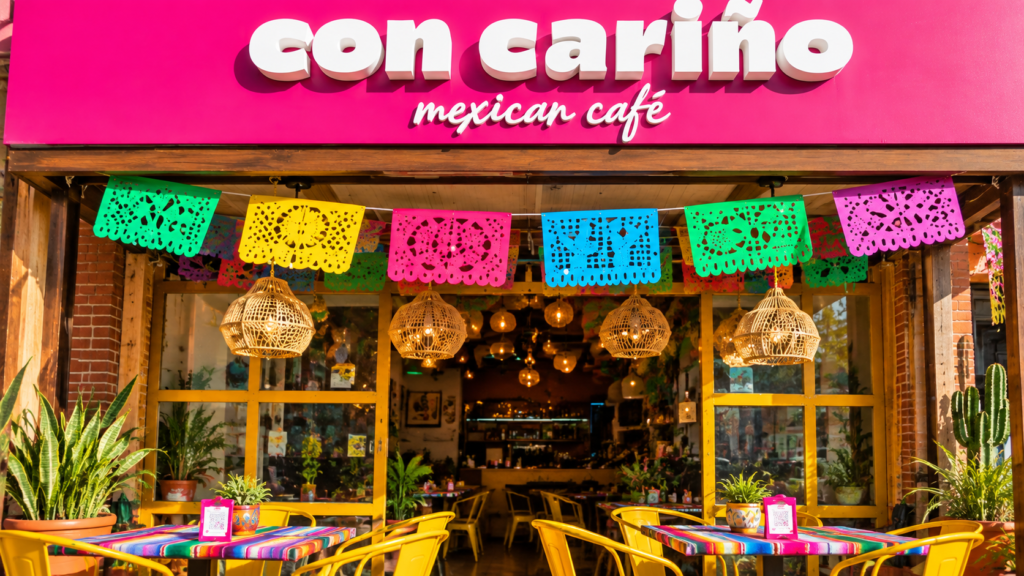
Con Cariño grew out of that journey.
We wanted to share the Mexican food and traditions that shaped us, while also honoring the country that welcomed us so warmly.
So when you sit down at Con Cariño and eat a handmade tortilla, try a fresh glass of agua fresca, or share a plate of tacos with friends, you’re getting a little piece of our story too.
It’s our way of sharing where we come from while continuing to learn from where we are.
Because culture isn’t something that has to stay in one place.
It travels with people.
It changes.
It meets new people and finds new homes.
And sometimes, somewhere along the way, two cultures that seem very different discover that they have been speaking the same language all along.
Feed your people. Welcome your guests. Take care of one another. Gather around the table.
That, to me, is a little bit of cariño.
And I’m grateful that Morocco gave us a place to share it.
